Source: ruthmiskin
Phonics for Kids is all about making learning letters and sounds interesting through really exciting activities. Kids learn best when they play games, listen to music, and do creative tasks that make them curious. With the correct Phonics for Kids Fun Activities, kids may learn to connect sounds with words in a fun way that helps them read and talk better while keeping learning light and social.
Role of Phonics in Early Literacy
Phonics is an important part of laying the groundwork for early literacy. Children learn how words are made by connecting sounds to letters. This makes reading and writing easy and fun. It gives kids a structured way to figure out what new words mean and helps them feel surer of their language skills.
For downloading the brochure of Phonics Course, Click Here!
Call or Whatsapp on +918104606573 / +919869546913, for details of Phonics Course!
The Role of Phonics in Early Literacy includes:
- Strong Reading Skills: Phonics helps kids see patterns in words, which helps them read quickly and accurately.
- Development of Spelling: Understanding how sounds and letters are related makes spelling less scary and more analytical.
- Better Vocabulary: When kids figure out how to read words, they naturally learn new words, which makes it easier for them to talk.
- Learning with Confidence: When kids can read and spell on their own, they feel more confident and want to read more.
- Base for Understanding: Strong phonics abilities free up mental resources so kids may focus on understanding what they read.
Phonics is a bridge that plugs the gap between spoken and written language. Phonics for Kids Fun Activities gives young learners the tools they need to succeed on their path to literacy.
5 Engaging Phonics Activities for Pre-schoolers
Phonics for Kids Fun Activities help Pre-schoolers connect sounds with letters in ways that are simple, engaging, and fun. When kids learn through play, they not only learn faster but also remember what they learnt better.
Let us have a look at the 5 Engaging Phonics Activities for Pre-schoolers:
Hunt for Sounds in the Room
Put cards with letters in different corners of the home or classroom. Say a sound and let the kids rush to the letter that goes with it. This makes learning more active.
Phonics Songs
Use fun tunes and jingles to teach kids how to say letters. Singing helps kids remember things and makes it easier for them to remember sounds while they read.
Games that match
Give out letter cards and graphic cards with pictures of a cat, ball, fan, etc. Tell the kids to match the picture with the correct foremost letter. This backs letters and sounds understanding.
Letters in Playdough
Foster kids to create letters with playdough while articulating the sound loudly. It mixes phonetic learning with artistic freedom.
Finding Story Sounds
When you read a short narrative, stop and ask the kids to point out words that start with a sound that is different from the others. This connects phonics practice to real-life reading.
These Phonics for Kids Fun Activities not only make learning delightful, but they also give kids the confidence for reading and writing in the future.
Fun and Effective Phonics Activities
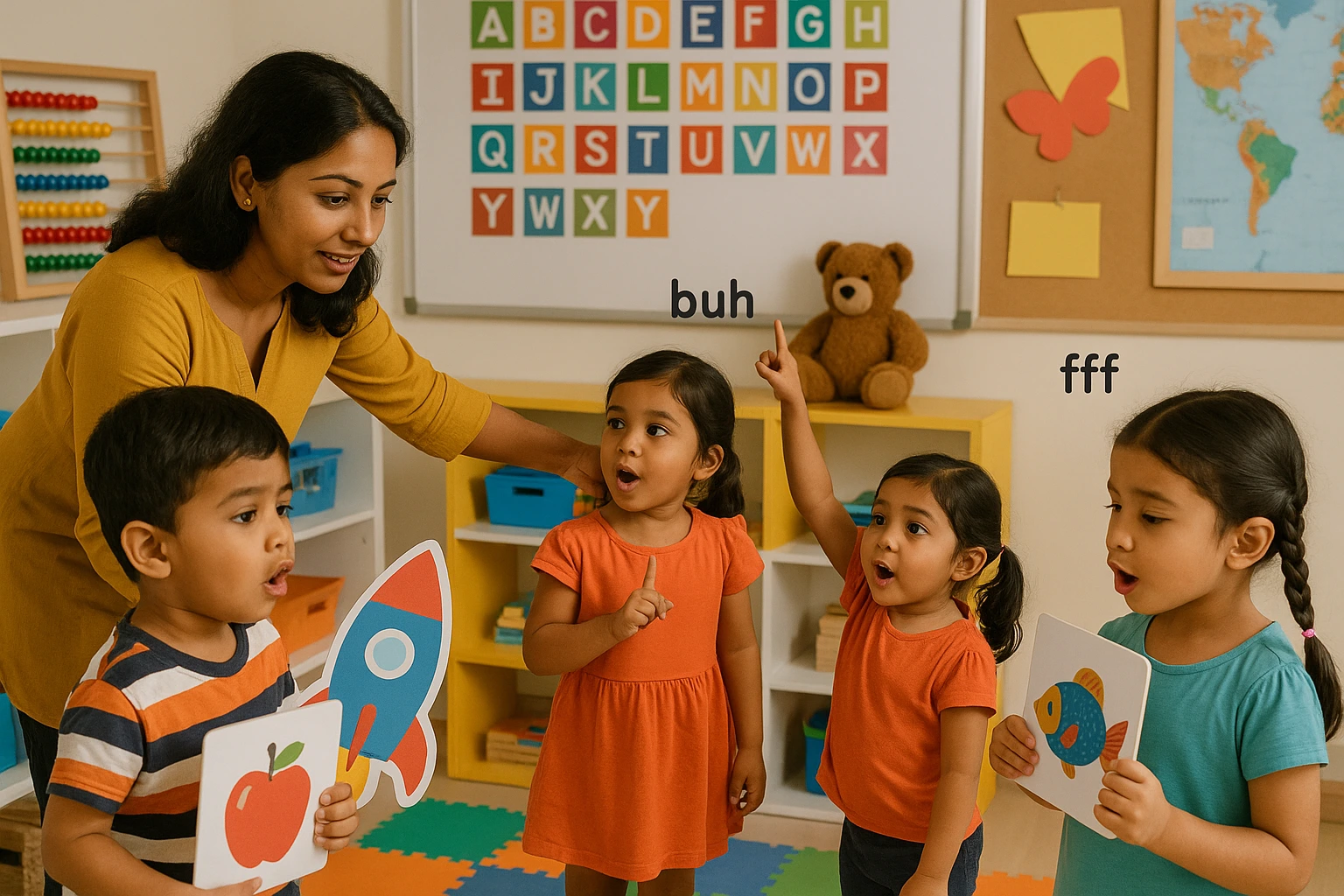
Phonics for Kids Fun Activities helps children associate sounds with letters in a vibrant way. Integrating play and study keeps kids energetic and interested.
A few Fun and Effective Phonics Activities are:
- Sound Quest:Place objects/cards in different spots around the room that begin with distinct sounds. Allow the kids to discover objects/cards with a specific sound and recite the sound loudly.
- Sound Clapping: Say a word slowly and ask the kids to clap for each sound they catch. It aids with phoneme mastery and listening proficiency.
- Letter-Sound Jumping on a hopscotch: Draw a hopscotch grid with letters. As children hop on each square, they must enunciate the corresponding sound.
- Sound Sorting Bins: Keep bins tagged with letters/sounds. Give children images or small objects to sort into the right bin.
- Rhyming Word Play: Say a word and ask children to come up with rhyming words. This promotes creativity while supporting phonics patterns.
By incorporating fun with learning, these Phonics for Kids Fun Activities are very effective and ensure that children not only practice phonics but also appreciate the process, making reading and writing skills more robust from an early age.
3 Must do Practices for Teaching Phonics that Kids Enjoy
Phonics instruction becomes more efficacious when children find it exciting and captivating. By integrating learning with enjoyment, teachers and parents can make phonics a delightful part of early education.
Here are 3 Must do Practices for Teaching Phonics that Kids Enjoy:
Active learning
Play Phonics for Kids Fun Activities like phonics bingo, sound hunts, or letter matching. Kids learn sounds and letters naturally while they play, without feeling like they have to.
Narratives and jingles
Narrating stories using repetitive sounds and jingles that rhyme makes understanding phonics natural. Kids associate sounds with actual words, which helps them read independently and comprehend what they mean.
Practical Activities
Promote kids to create letters with Phonics for Kids Fun Activities using clay, sand, blocks, etc. Tactile learning not only boosts creativity but also supports sound and letter connections in a delightful way.
These phonics games and Phonics for Kids Fun Activities make sure that phonics learning stays fun and effective, helping kids build proficient reading and writing skills from the very beginning.

How to Teach Phonics through Games
Learning through Phonics for Kids Fun Activities and games makes kids curious and keeps them involved, turning phonics learning into an exciting journey. Phonics for Kids Fun Activities can be both wonderful and effective with dynamic classroom experiences, helping children naturally retain learning. Teachers receive real-world training in this Phonics Teacher Training Course, which helps them make learning lively and smooth.
Let us see How to Teach Phonics through Games:
- Bingo cards: Design bingo cards with letters/images. Say a sound, and the kids have to mark the right letter or picture. This helps you get better at listening and recognising things.
- Phonics Hopscotch: Make a hopscotch grid with letters or blends. Kids say the sound loudly as they bounce on each grid. It blends learning with motion.
- Recollection Game: Create card pairs, each with a letter (e.g., p) and a picture (e.g., pot) respectively. Kids turn cards to make suitable fits, boosting the symbol-sound bond.
- Treasure Hunt: Hide objects in the room, commencing with diverse sounds. Kids search, gather, and enunciate the sounds, making phonics training interactive and exciting.
- Rhyming Word Challenge: Say a word, and allow children to come up with rhyming words. It boosts phonemic understanding and enhances vocabulary.
Educators can gain brilliant pedagogy skills through specialized training. A Phonics Teacher Training Course available at the Vidhyanidhi Education Society (Govt. Regd.), an esteemed institute, strives to equip aspiring educators with modern instruction methods and means to develop Phonics for Kids Fun Activities. Parents eager to contribute to their kids’ learning can also benefit by registering for this Phonics Teacher Training Course.
Boost reading skills—join Vidhyanidhi’s Phonics Course and see the change!
For downloading the brochure of Phonics Course, Click Here!
Call or Whatsapp on +918104606573 / +919869546913, for details of Phonics Course!
FAQs
How can we Make Phonics Learning Fun for Pre-schoolers?
Make phonics interesting by using narratives, plays, melodies, etc. Kids stay interested in practical activities that help them learn to recognise letters and sounds.
How Much Time Should we Spend on Phonics Each Day?
Spend 15 minutes every day on phonics. Brief, systematic practice makes reading aptitudes stronger. The Vidhyanidhi Education Society also offers skilled assistance.